


Probabilistic Simulation
Technical systems work typically instable under different uncertainty environments. Their characteristics vary depending on the usage conditions as temperature, air humidity, erosion etc. For quality and reliability, these realistic aspects as variability, uncertainty, tolerance and error must be incorporated to design stage of technical systems. The variability is usually characterized by a stochastic distribution. The deterministic simulation cannot predict the real system behaviors, because it shows only ideal nominal system response by nominal parameters without any uncertainty. In contrast, probabilistic simulation can predict the real system behaviors under uncertainties. Based on a external deterministic model by available interfaces, input parameters will be considered as stochastic distributions in OptiY and the output distributions will be calculated out. Thus, the system behavior can be predicted by a probability distribution function accurately.
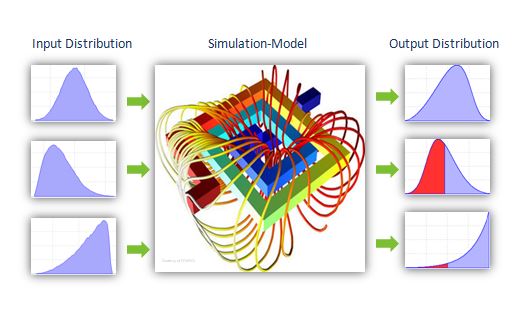
The great challenge of the probabilistic simulation is the long computing time of large deterministic system models. The accuracy of the stochastic distributions depends by Monte Carlo sampling on the sample size and the number of stochastic parameters. Applicable result requires a great sample size as thousands of calculations of the original model. Therefore, Monte Carlo simulation by aceptable computing time leads only to poor accuracy of the output distributions, which is incorrect and predicts mistakes for design decisions. With novel meta-modeling technology, OptiY can perform probabilistic simulation fast and accurately. Furthermore, probabilistic simulation of nonlinear dynamical system can be done by OptiY. It will help engineer to get a deeper and informative look into the inner life of dynamical systems improving reliability and quality.
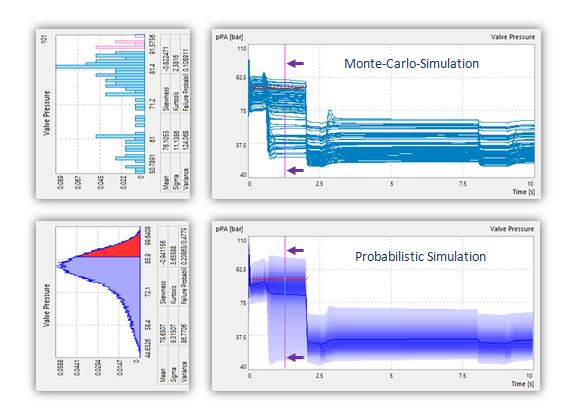
Comparison of Monte-Carlo-Simulation and Probabilistic Simulation
Case Studies
- Robust Design of an Actuator Assembly for high-precision Positioning under static Aspect
- Robust Design of Induction Motor
- Robust Design of a Hydraulic Cylinder Drive
- Uncertainty Analysis of Longitudinal Vehicle Dynamics
- Robust Design of a Cohn Filter Circuit


